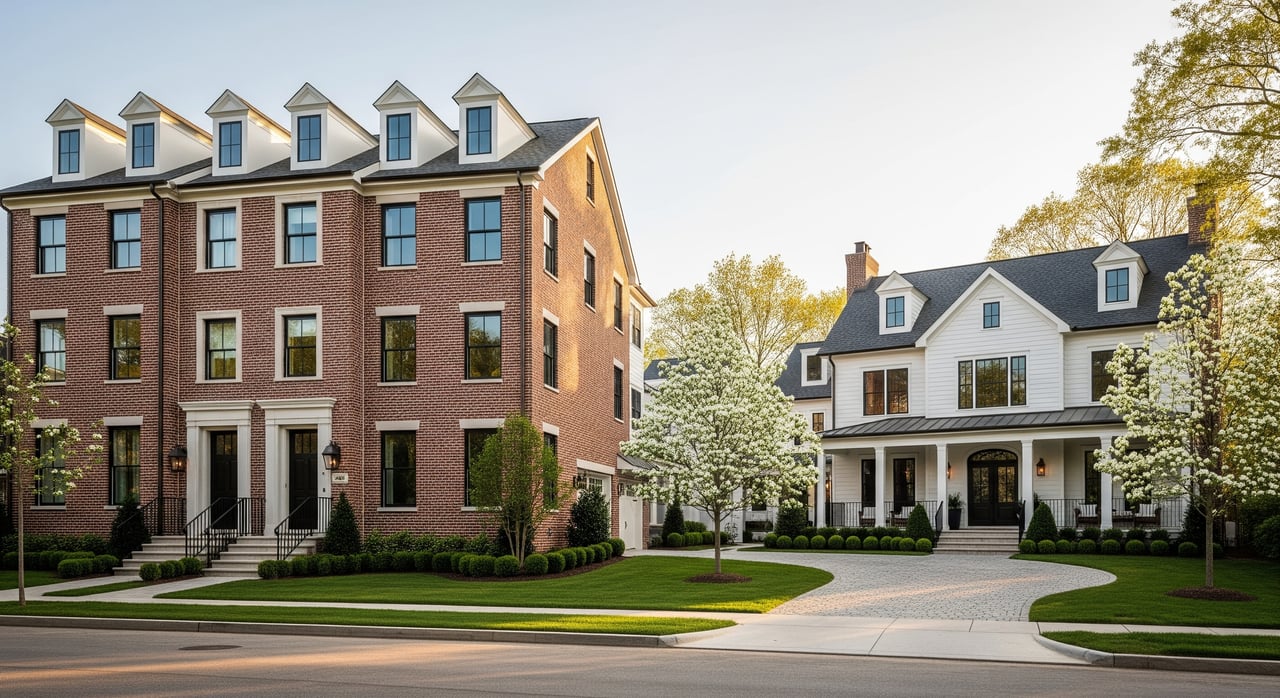
Trying to decide between a townhome and a single-family house in Matthews? You’re not alone. Many first-time and relocating buyers want a clear, apples-to-apples monthly cost comparison before they choose. In this guide, you’ll learn how to calculate the total cost of ownership for both options in Matthews, what to ask for during due diligence, and how to weigh lifestyle tradeoffs so your choice fits your budget and your day-to-day. Let’s dive in.
What drives total cost in Matthews
Your monthly cost is more than your mortgage. In Matthews, key drivers include purchase price and financing, property taxes, HOA dues, maintenance and repairs, utilities, insurance, and closing costs like PMI. Resale trends and financing complexity can also affect long-term value and liquidity.
The numbers are local. In Mecklenburg County, tax rates, HOA rules, and utilities vary by community and can change over time. Plan to verify every number with local sources and recent listing documents before you decide.
Step-by-step: Build your Matthews cost comparison
Purchase price and financing
- What to collect:
- Median or target price for townhomes and single-family homes in Matthews based on the last 3 to 12 months of local comps.
- Down payment scenarios you are considering, such as 3 to 5 percent for first-time buyers or 20 percent conventional.
- Current mortgage rates and lender notes on attached property underwriting.
- How to calculate:
- Loan amount = Purchase price − Down payment.
- Monthly principal and interest = lender amortization using your quoted rate and term.
- Pro tip: Model at least three scenarios for each property type with low, mid, and high price points so you see your range, not a single number.
Property taxes
- What to collect:
- Mecklenburg County tax rate and how the county assesses value for your property type.
- Any municipal or special district levies applicable inside Matthews.
- How to calculate:
- Annual property tax = Assessed value × tax rate. Assessments can lag market price, so confirm the most recent assessed value for the specific property.
- Practical notes:
- Ask your lender about escrowing taxes in your monthly payment.
- Confirm billing cycles and due dates with the Mecklenburg County Tax Collector.
HOA dues and special assessments
- What to collect:
- Current monthly HOA dues for specific townhome communities you’re targeting. Some single-family neighborhoods also have HOAs, while others do not.
- What dues include and exclude. Look for exterior maintenance, roof, master insurance, lawn care, amenities, trash, and reserves.
- Any recent or pending special assessments, plus reserve funding status.
- How to calculate:
- Annual HOA cost = Monthly dues × 12 + any scheduled or known assessments.
- Practical notes:
- Read CC&Rs, the budget, reserve study summary, and meeting minutes. Coverage varies, and gaps or high master policy deductibles can shift costs to owners.
Maintenance and repairs
- What to collect:
- Age and condition of the roof, HVAC, water heater, appliances, exterior surfaces, driveway, and landscaping.
- Local yard-care quotes if you plan to outsource mowing, leaf cleanup, or seasonal work.
- How to estimate:
- Label this as a rule-of-thumb: the “1 percent rule” suggests annual maintenance of about 1 percent of purchase price. Older homes or large yards can run 1 to 3 percent. For townhomes with exterior covered by the HOA, interior-only maintenance may be closer to 0.5 to 1.5 percent.
- Reserve for one-time replacements by estimating the remaining life and cost of major systems.
- Practical notes:
- HOAs can shift some long-term exterior costs away from the owner, but reserves and special assessments matter. Verify how the community plans to fund future replacements.
Utilities in Matthews
- What to collect:
- Typical monthly electricity rates and usage from Duke Energy for the Charlotte area.
- Water and sewer base charges and usage rates from the Town of Matthews or the local provider.
- Trash and recycling fees if not included in town services or HOA dues.
- Natural gas rates if the home uses gas heating, water heating, or cooking.
- How to compare:
- Townhomes often use less energy due to shared walls and smaller square footage. Single-family homes with larger yards, older systems, or pools may have higher utility bills.
- How to calculate:
- Annual utility cost = Sum of typical monthly bills × 12.
- Practical notes:
- Ask sellers for 12 months of utility bills. Use ENERGY STAR or similar tools for estimates if bills are unavailable.
Homeowner’s insurance
- What to collect:
- Local quotes for HO-3 (single-family) and HO-6 (townhome/unit-owner) policies.
- Details of the HOA’s master policy for townhomes, including what the master covers and the deductible.
- Flood risk for the specific property using official maps.
- What to expect:
- HO-6 premiums are often lower than HO-3 because the master policy may cover exterior structure, but owners still need walls-in coverage, personal property, and loss assessment coverage where appropriate.
- How to budget:
- Annual insurance = Quoted premium + note any master policy deductible risk.
Closing costs, PMI, and ongoing financing costs
- What to collect:
- Typical buyer-paid closing costs in Mecklenburg County from your lender.
- PMI quotes if your down payment is under 20 percent.
- Any condo or townhome review fees your lender may require.
- Practical notes:
- Condo and townhome financing can include extra documentation and timelines. Ask your lender early about the specific community you’re considering.
Resale and liquidity
- What to collect:
- Recent price trends and days on market for Matthews townhomes and single-family homes.
- What to know:
- In many suburban markets, single-family homes command a premium for land and tend to be more liquid. That said, walkable locations and newer townhome developments can see strong demand. HOA rules like rental caps can influence resale.
Plug-and-play cost template
Use this template to compare one Matthews townhome and one single-family home side by side. Replace variables with your local numbers and lender quotes.
Inputs you’ll gather
- P_SF = Single-family purchase price
- P_TH = Townhome purchase price
- DP = Down payment percent or dollars
- Rate = Mortgage interest rate
- Term = Loan term in years
- TaxRate = Effective property tax rate
- HOA_month_SF = Monthly HOA for house (if any)
- HOA_month_TH = Monthly HOA for townhome
- Maint_rate_SF = Annual maintenance rate for house
- Maint_rate_TH = Annual maintenance rate for townhome
- Utilities_SF = Average monthly utilities for house
- Utilities_TH = Average monthly utilities for townhome
- Ins_SF = Annual insurance premium for house
- Ins_TH = Annual insurance premium for townhome
- PMI_month = Monthly PMI if applicable
Formulas
- Loan amount = Price × (1 − DP)
- Monthly principal and interest = lender amortization result using Rate and Term
- Annual tax = Assessed value × TaxRate
- Annual HOA = HOA_month × 12
- Annual maintenance = Price × maintenance rate
- Annual utilities = Monthly utilities × 12
- Annual insurance = Quoted premium
Total annual and monthly cost
- Total annual cost = Annual principal and interest + Annual tax + Annual HOA + Annual maintenance + Annual utilities + Annual insurance
- Total monthly cost = Total annual cost ÷ 12 + PMI_month (if applicable)
Hypothetical example only
This illustration uses placeholder numbers so you can see how the math stacks up. Replace every input with current Matthews data and lender quotes before deciding.
- P_SF = $520,000; P_TH = $380,000
- DP = 10 percent; Rate = lender quote; Term = 30 years
- TaxRate = use Mecklenburg County rate
- HOA_month_SF = $0 or the actual subdivision fee
- HOA_month_TH = $275
- Maint_rate_SF = 1.25 percent; Maint_rate_TH = 0.75 percent
- Utilities_SF = $280; Utilities_TH = $200
- Ins_SF = $1,600; Ins_TH = $900
- PMI_month = lender quote if DP < 20 percent
Run the formulas above for each property to get your total monthly cost. Then change one variable at a time. For example, see how a $50 change in HOA dues or a 0.25 percent rate change affects your monthly bottom line.
Lifestyle tradeoffs to consider
Yard and outdoor space
- Single-family: typically larger yards for gardening, play, and pets, with higher time or service costs.
- Townhome: smaller private areas or shared greenspace, which reduces yard work but limits private outdoor space.
Privacy, noise, and parking
- Single-family: more separation and private driveways or garages.
- Townhome: shared walls can affect noise transfer. Parking and guest spaces may be governed by HOA rules.
Amenities and community
- Townhomes often include amenities like a pool, fitness center, or common areas funded by HOA dues.
- Single-family homes may not have shared amenities unless in an HOA subdivision.
Rules and restrictions
- HOAs use architectural controls and rules that can limit exterior changes, rentals, or certain uses.
- Homes outside HOAs provide more flexibility but shift more maintenance to you.
Commute and proximity to downtown Matthews
- Some townhome communities cluster near downtown Matthews for convenient shops and events.
- Single-family options can be a bit farther out and quieter, depending on the neighborhood.
A simple decision framework
Use this scoring approach to compare two specific properties. Score each category from 1 to 10 based on how well it fits your needs, then apply the weight.
- Monthly cost total: 30 percent
- Desired outdoor/private space: 20 percent
- Maintenance tolerance and time: 15 percent
- Amenities and community features: 10 percent
- Resale and liquidity: 15 percent
- Financing complexity and HOA risk: 10 percent
Steps:
- Score each category for the townhome and the house.
- Multiply each score by the weight.
- Add the weighted scores to get two totals.
- The higher total indicates the better fit for your priorities.
Next steps for Matthews buyers
- Pull recent comps for target neighborhoods and property types.
- Confirm Mecklenburg County property tax rate and request a tax estimate for each address you’re considering.
- For any townhome, request HOA documents: CC&Rs, budget, reserve study summary, and recent meeting minutes.
- Ask sellers for 12 months of utility bills.
- Get two insurance quotes: HO-3 for a single-family house and HO-6 for a townhome. Reference the HOA master policy details.
- Secure a mortgage preapproval and ask about condo or townhome underwriting for your specific community.
- Obtain yard-care or contractor quotes if you plan to outsource maintenance.
- During contract, include an HOA document review period and allow time for lender condo review if needed.
- Schedule a thorough home inspection and price out any repairs.
Final thoughts
A townhome in Matthews can deliver lower maintenance, possible utility savings, and community amenities for a predictable monthly fee. A single-family home can offer more space, privacy, and land that often holds value well in suburban markets. The right choice comes down to your total monthly cost, your tolerance for maintenance, and the lifestyle that helps you thrive.
If you want a clear side-by-side using actual Matthews numbers, reach out. I’ll organize the comps, HOA details, tax estimates, and quotes, then build a custom worksheet so you can decide with confidence. Start your move with a local expert by contacting Alton Garrard.
FAQs
What usually costs less per month in Matthews, a townhome or a house?
- It depends on the home, HOA dues, utilities, and maintenance; run the full cost template for both and compare monthly totals.
How do property taxes differ for Matthews townhomes vs houses?
- Taxes are based on assessed value times the Mecklenburg County rate; confirm the current assessment and rate for each address before estimating.
What do Matthews HOA dues typically cover in townhome communities?
- Coverage varies, but many include exterior maintenance, master insurance, and amenities; verify inclusions, reserve funding, and any pending assessments in the HOA documents.
Are townhomes harder to finance than single-family homes?
- Some lenders require additional condo or townhome reviews and HOA documentation; ask your lender early about the specific community’s approval status.
Will I save on utilities in a Matthews townhome?
- Often yes due to shared walls and smaller space, but actual bills depend on HVAC efficiency, insulation, and usage; request 12 months of seller utility bills.
How should I estimate maintenance for a Matthews property?
- Use a rule-of-thumb rate: about 1 to 3 percent of price for houses based on age and yard size, and about 0.5 to 1.5 percent for townhomes where the HOA covers exterior items.
What resale factors should I consider when choosing between a townhome and a house?
- Look at recent comps, days on market, location, HOA rules like rental caps, and the presence of desirable amenities; single-family homes often command a premium for land in suburban markets.