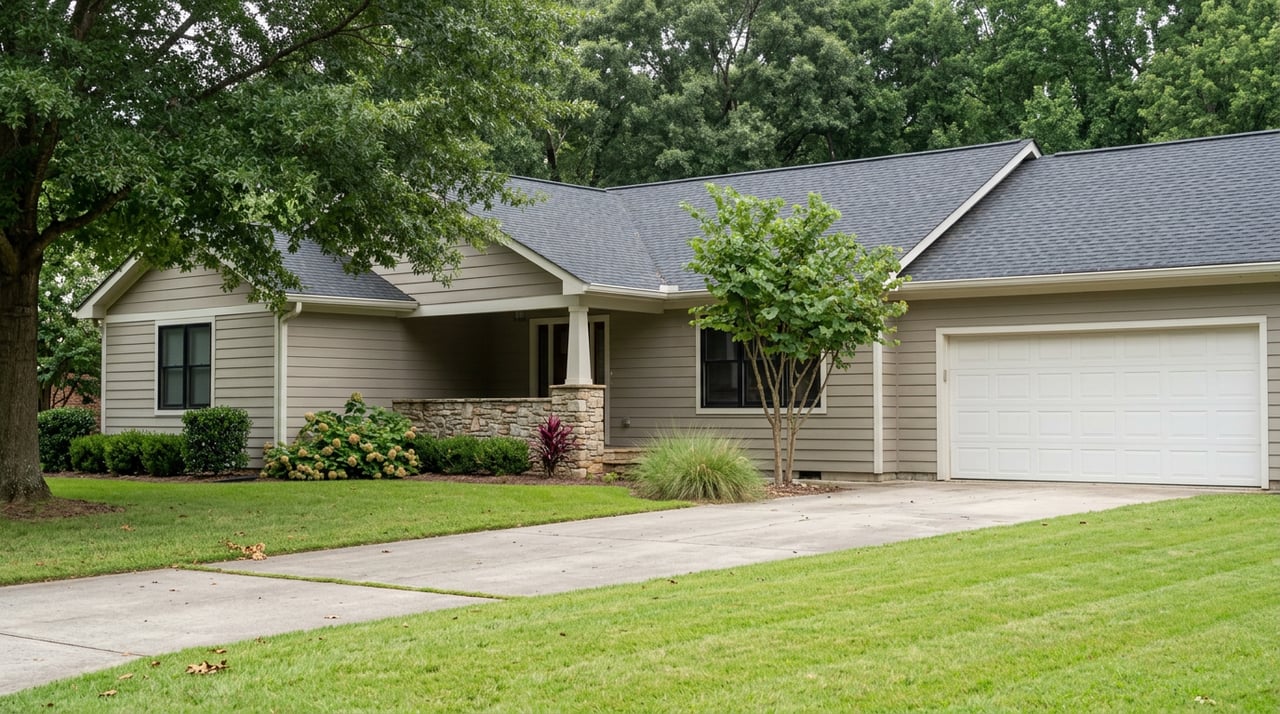
What if the fourth bedroom in the listing you toured last weekend doesn't legally exist?
Not in the sense that the room isn't there. The framing is real, the closet is real, someone probably slept in it last night. But if that Mint Hill home sits on a septic system, the county doesn't care how many bedrooms the floor plan shows. It cares how many bedrooms the original permit allows, and in the town's older, larger-lot neighborhoods, those two numbers don't always match. That gap is the friction that catches buyers off guard after they've already fallen for the house, and it's worth understanding before you write an offer, not after.
The Number on the Permit, Not the Number in the Listing
North Carolina requires sellers to complete a Residential Property and Owners' Association Disclosure Statement before a buyer submits an offer. Among the required entries: the type of sewage disposal system, and if that system is a septic system, the number of bedrooms the permit allows. State administrative rule spells this out directly as one of the items a disclosure form must include.
Septic permits aren't decorative paperwork. They set a design capacity, generally calculated around two people per bedroom, and that capacity is what the drain field was engineered to handle. A North Carolina Real Estate Commission bulletin on the subject is blunt about the consequence: a home connected to an on-site septic system should be represented as having the number of bedrooms the permit allows, not the number of bedrooms someone built or converted later.
In practice, this means a home advertised as a 4-bedroom in an established Mint Hill neighborhood might carry a permit written for 3. Maybe a previous owner finished a bonus room over the garage. Maybe an addition went in without updating the septic paperwork. Either way, that unpermitted bedroom becomes a real problem the moment a lender's appraiser or your own agent asks the question.
A septic permit sets a hard ceiling on how many bedrooms a home can be represented as having, and that ceiling doesn't move just because the floor plan grew.
The Commission's guidance also flags that permits sometimes restrict use of a dishwasher or garbage disposal, another detail that rarely makes it into a listing description but absolutely affects how a home lives day to day.
Two Mint Hills, One Median Price
This is where Mint Hill's housing stock splits into two genuinely different buying experiences, and why the town's median price hides more than it reveals.
On one side sit the newer HOA communities: Cheval, a 425-acre community with equestrian amenities where homes were built between 2008 and 2026 on lots ranging from roughly 0.69 to 1.93 acres, and Whitley Preserve, where builders including Lennar's Grisham Collection and David Weekley Homes have delivered new construction with public water and sewer already run to the lot line. In these neighborhoods, the HOA dues (one Cheval listing carried an annual fee of $2,445, and a newer Cheval section lists dues around $204 a month) typically cover ground maintenance, and the due diligence conversation centers on reserve funds, covenant restrictions, and whether the association can cover a major repair without a special assessment.
On the other side sit the town's established, larger-lot neighborhoods, places like Farmwood and the older sections of Allen Park, where homes sit on private wells, septic tanks, and lots that often stretch past half an acre. Here the due diligence conversation is different. Buyers pay closer attention to the septic system, driveway length, drainage, and how the lot handles heavy rain. It's not a dealbreaker. It's simply a different checklist, and it's one that a 30-minute walkthrough won't reveal.
| HOA / newer construction (Cheval, Whitley Preserve) | Septic / larger-lot (Farmwood, established Allen Park) | |
|---|---|---|
| Water and sewer | Public, connected at the curb | Private well and septic tank |
| Ongoing dues | HOA fee (often $200 to over $2,400 a year) | Typically no HOA |
| Core due diligence | Reserve study, covenant review, special assessment risk | Septic permit bedroom count, drain field condition, private road agreements |
| Typical lot size | Often under an acre | Often half an acre to several acres |
Neither column is better. They're just different transactions, and a buyer who assumes every Mint Hill home comes with the same closing checklist is going to miss something.
What the County Actually Has on File
Before writing an offer on a septic-served home, Mecklenburg County Public Health's Environmental Health division, based at 3205 Freedom Drive in Charlotte, maintains the plan review and permitting records for onsite wastewater systems and private wells across the county, including Mint Hill. The county also runs a septic system permit status lookup tool online, which can confirm whether a hold exists on a permit before you go further into a contract.
This is a five-minute call or a quick tool check that can save weeks of renegotiation later. If the county's file shows a 3-bedroom permit on a home marketed as a 4-bedroom, that's a conversation to have with your agent and the seller before due diligence ends, not a surprise your lender's appraiser brings to your attention during underwriting.
The Private Road Wrinkle
Larger-lot properties in Mint Hill sometimes sit at the end of a private drive or a shared easement rather than a state-maintained road. North Carolina's disclosure rule requires sellers to note whether a private road abuts or adjoins the property and whether a maintenance agreement governs it. If no agreement exists, or if one exists but hasn't been followed, that's a cost and a liability question that doesn't come up at all in a curb-cut, sidewalk-lined HOA section like Whitley Preserve.
It's also worth remembering that even homes connected to municipal water and sewer aren't entirely free of this kind of hidden responsibility. The line running from the street to the house is typically the homeowner's responsibility to maintain, and damage to that line from tree roots isn't usually covered by a standard homeowners policy. The difference in Mint Hill's older neighborhoods is that this list of homeowner-only responsibilities gets longer: septic tank, drain field, private well, sometimes a private road, all before the actual house itself enters the conversation.
What This Means at the Negotiating Table
If a seller doesn't hand you the completed disclosure statement by the time you submit your offer, North Carolina law gives you the right to cancel the contract, provided you deliver written notice within three calendar days of receiving the statement or three calendar days from the contract date, whichever comes first. That right disappears once you've closed or moved in, so it's not a safety net worth relying on. It's a deadline worth watching.
As of August 2026, Mint Hill's median list price sat at $585,000, essentially flat compared to the same month a year earlier, with homes typically taking well over 100 days to sell. That timeline isn't uniform across the town. A septic-served, larger-lot home in an established neighborhood often takes longer to move through due diligence simply because there are more systems to verify: well, tank, drain field, sometimes a private road agreement. A newer HOA home with public utilities clears that stage faster because most of what a lender needs is already a matter of public record. If your Mint Hill search spans both kinds of neighborhoods, build extra time into your offer timeline for the older, larger-lot side of that comparison.
Quick Answers
Does every septic-served home in Mint Hill have this bedroom mismatch problem? No. Many permits match the home's actual bedroom count exactly. The point isn't that a mismatch is common, it's that it's invisible until someone checks, and the county record is the only place that check happens.
Can I ask for a septic inspection even if the seller says the system is fine? Yes. A pre-sale septic inspection is a private arrangement between buyer, seller, and a licensed inspector. It isn't required by state statute, but most lenders require one before funding a loan on a home with a private system, which makes it effectively standard practice for financed purchases.
What happens if the inspection finds a problem? A failed inspection is a negotiating point, not an automatic end to the deal. Buyers commonly ask for a price reduction, a repair credit, or a repair escrow rather than walking away.
Mint Hill's larger lots and quiet streets are worth the extra homework, but the homework is different depending on which side of town you're shopping. If you want a second set of eyes on a septic permit before you write an offer, or you're trying to figure out whether an HOA community or an established larger-lot neighborhood fits how you actually want to live, Alton Garrard has walked this exact comparison with buyers across Mint Hill and can help you start your move with a local expert.