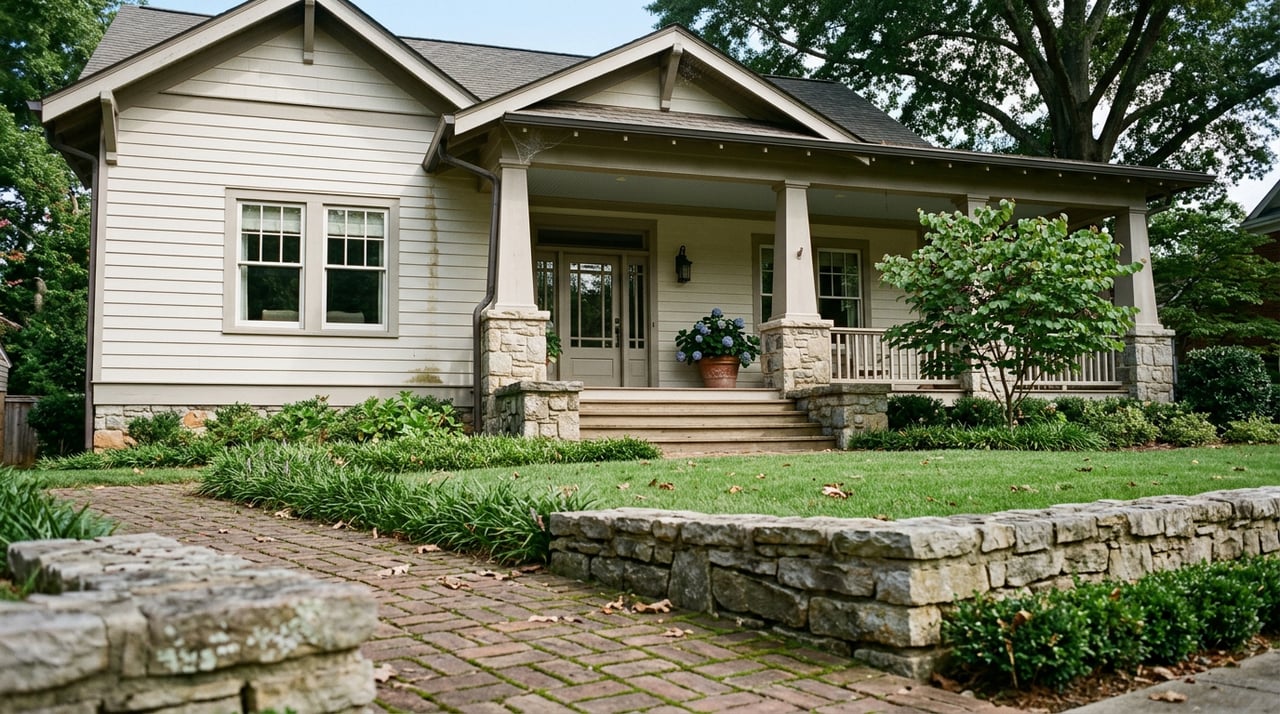
A buyer who falls for a bungalow on a Dilworth side street usually assumes the path from contract to renovated dream house looks like it does everywhere else: pull a permit, hire a contractor, get inspected, done. Then they learn their new window, their new porch, or their new addition first has to clear a body most Charlotte homeowners never think about: the Historic District Commission, a group that meets once a month and reviews exterior changes against a set of preservation standards before the city will issue a building permit, as the City of Charlotte's Unified Development Ordinance requires.
That approval process is one difference between a home inside Dilworth's Local Historic District and a nearly identical one two blocks away.
Your Renovation Isn't Approved by the City Desk. It's Approved by a Committee.
Any exterior work visible from the street on a property inside Dilworth's Local Historic District needs a Certificate of Appropriateness, a document issued by the Historic District Commission before a building permit can be issued at all. That's not a rubber stamp. The commission evaluates projects against the Secretary of the Interior's Standards for Rehabilitation, the same federal preservation framework used across the country, and its own local design standards for the district, as the April 2026 case file for 2126 Charlotte Drive notes.
The commission itself is built to reflect Dilworth's outsized share of Charlotte's historic housing stock. Under the city's rules of procedure, its members include a representative for each of Charlotte's local historic districts, one seat reserved specifically for a business operator of Dilworth, and four at-large members, one of whom sits on the Planning Commission. Dilworth is one of eight neighborhoods in Charlotte carrying this local historic designation, alongside districts like Wilmore, Fourth Ward and Wesley Heights, but its size and market activity make it the commission's busiest docket most months.
Most Projects Clear Fast. The Ones That Don't Can Run for Months.
Not every change triggers a full hearing. The City of Charlotte's HDC FAQ says routine items such as fences, signage, window and door swaps, driveways, walkways and rear-yard improvements typically only need administrative sign-off from city staff, a much faster path. Larger changes, including new construction, additions, demolition, front or side porch enclosures, substitute siding, large accessory buildings and major tree removal, go to the full commission for a vote.
The gap between those two tracks shows up clearly in the city's own 2026 case files. A window and masonry project at 2126 Charlotte Drive got its initial hearing on April 8, 2026, but staff came back with follow-up questions on brick and mortar samples and window specifications, pushing the required decision date out to September 7, 2026, nearly five months after the first hearing. A demolition application for a structure at 316 Rensselaer Avenue was still listed as continued from the commission's January 14, 2026 meeting when it reappeared on the April and May 2026 agendas, meaning a single demolition request stayed open for four months or longer before resolution.
Compare that with 1207 Belgrave Place, where an accessory building addition cleared as a consent-agenda item at the same April 2026 meeting, built on a Certificate of Appropriateness the owner had already used successfully back in 2023 for a matching pool deck. Different streets, same commission, wildly different timelines.
The house doesn't set the timeline. The scope of the exterior work does. A fence clears in weeks. A demolition can take a season.
A Certificate of Appropriateness, once issued, is only good for twelve months, as the 1207 Belgrave Place case file states. If a buyer inherits an older approval and doesn't pull a building permit within that window, the certificate lapses and the project has to go back through review from scratch, a detail worth checking before assuming a previous owner's paperwork still covers your plans.
The Local Historic District and the Nearby Market
The review process is one feature that distinguishes properties inside the Local Historic District from those nearby.
The January 2026 figures put the median sale price inside Dilworth's Local Historic District at $1.1 million, up 5.7% from the year before, while the broader Dilworth footprint—which includes blocks just outside the boundary—ran closer to $600,000 to $665,000 over roughly the same stretch.
Inside the boundary, demolition is subject to commission review. The Rensselaer Avenue case shows that a review can continue across multiple monthly meetings.
For context on just how tight the surrounding market already is, the Canopy Realtor Association's own January 2026 report put the City of Charlotte's median sales price at $410,000, with months of supply at 2.4, well below the 5 to 6 months considered a balanced market. Dilworth's Local Historic District sits inside an already undersupplied city and adds a second layer of scarcity on top of it.
One clarification worth making here: the Dilworth Community Association, the neighborhood's all-volunteer nonprofit founded in the late 1960s, has no dues and is explicitly not a homeowners association. It runs the neighborhood's home tour and land-use committees, but it has no design authority. Only the city's Historic District Commission can approve or deny an exterior change. Buyers sometimes conflate the two, and it matters, because the DCA can't help you with a Certificate of Appropriateness. The city can.
| Inside the Local Historic District | Just outside the boundary | |
|---|---|---|
| Median sale price (early 2026 data) | Roughly $1.1 million | Roughly $600,000 to $665,000 |
| Exterior renovation approval | Certificate of Appropriateness from the HDC required | Standard city permit process |
| Typical timeline for minor work | Administrative approval, often fast | Standard permit turnaround |
| Typical timeline for additions, new construction or demolition | Full commission hearing, sometimes several months | Standard permit turnaround |
| Teardown and rebuild | Restricted by design review and demolition procedures | Market-driven |
What Changes the Day You Cross the Boundary Line
Because "Dilworth" as a marketing term covers more ground than the Local Historic District actually does, the first thing worth confirming on any specific address is which side of that line it sits on. A house can be a hundred years old and sit outside the boundary, or a newer infill build can sit inside it if it stands on a lot within the district. The boundary, not the age of the house, determines whether the Historic District Commission has a say in your renovation.
If a project involves anything beyond routine maintenance, budget for the possibility of a full hearing rather than assuming administrative approval. Ask a seller whether any existing Certificate of Appropriateness is still within its twelve-month window. And if a demolition or a major addition is part of the plan, build in months, not weeks, for commission review, especially if the property has features the commission would consider character-defining.
Quick Answers
Does every exterior change in Dilworth require Historic District Commission approval? Only if the property sits inside the Local Historic District boundary. Even then, routine items like fencing, signage and window or door replacement usually only need administrative approval from city staff. Larger changes such as additions, new construction, demolition and major tree removal require a full commission hearing.
Is the Dilworth Community Association the same as a homeowners association? No. The DCA is an all-volunteer nonprofit with no dues and no design authority. Design review for exterior changes inside the Local Historic District is handled entirely by the city's Historic District Commission.
How long should I budget for approval if I'm buying a fixer-upper inside the historic district? For minor work, administrative approval can move quickly. For anything requiring a full hearing, plan for a longer process if staff requests revisions or the project involves demolition.
Buying inside Dilworth's Local Historic District means buying both a house and a process. Knowing which side of that boundary a property sits on, and what kind of renovation it can realistically clear, is the difference between a smooth close and a permit that takes half a year longer than expected. Alton Garrard works this market block by block, from the historic core to the edges just outside it, and can help you figure out which side of that line makes sense for what you're trying to do. Start your move with a local expert.
This article is general information, not legal, tax or financial advice. Consult a qualified professional about your situation.